
You don't have to face this alone
A crash changes your day in seconds: the damaged car, the pain that shows up later, the calls from the insurance adjuster. We take over the legal side so you can focus on getting better.
From day one we protect your case so you can focus on what matters most: getting better.
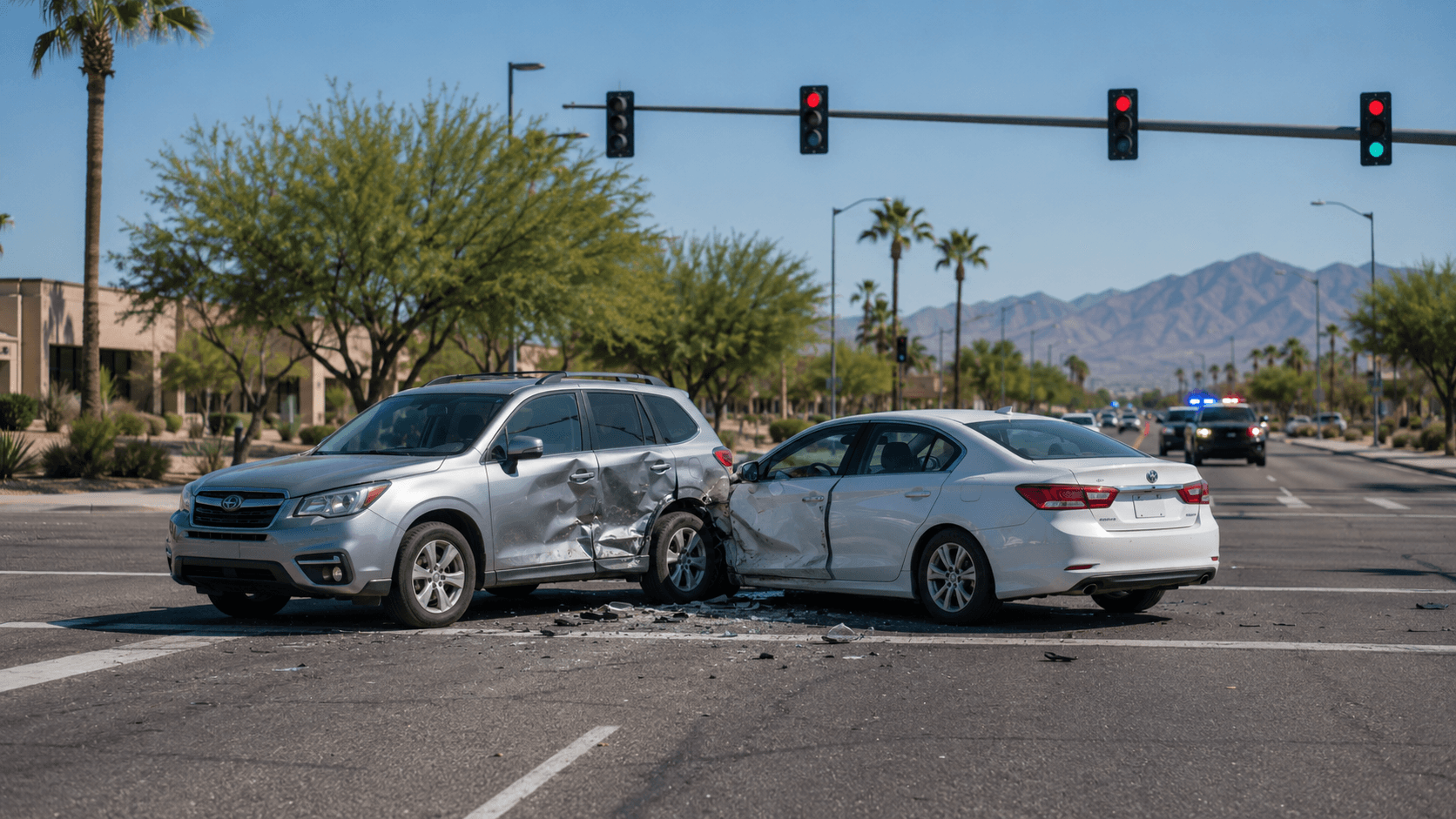
We handle accidents involving every kind of vehicle
Sedan, family car, coupe or pickup: if you were hit in Arizona, your case matters to us. Illustrative images.
- Sedan

- Family car

- Coupe

- Pickup

What we do for you
- We talk to the insurance company for you, so your own words are never used against you.
- We gather the police report, photos, witnesses and your medical records.
- We work out what your case is really worth — not the first lowball offer.
- If a fair settlement isn't on the table, we're ready to fight for one.
Cases we handle
- Rear-end collisions
- Drivers who ran a red light or stop sign
- Texting and distracted-driving crashes
- Uninsured or underinsured drivers
- Neck, back and concussion injuries
The causes we see again and again
Almost no crash is pure bad luck. Behind most of them is a decision somebody got wrong:
- The phone. A three-second text at 45 mph is roughly the length of a football field driven blind.
- Following too closely, then not stopping in time.
- Misjudged left turns at intersections with arrow signals.
- Lane changes without checking the blind spot — common on the US-60 and the Loop 202.
- Driving tired or after drinking, especially at night and on weekends.
Evidence that can decide your case
Much of this evidence only exists for a few days. The sooner we start, the more of it we can save:
- The accident report and the diagram the officer drew.
- Photos of where the cars ended up, the damage and the roadway.
- Video from nearby business or home cameras, which usually overwrites itself.
- Data from the car's onboard module (the "black box") in newer vehicles.
- Your medical records, which tie each injury to the date of the crash.
- Names and phone numbers of witnesses before they move on and forget.
Where the crash happened changes what can be proven
A freeway crash and a parking-lot crash are not the same case. The location decides which rules apply and what evidence will still exist a month from now:
- On the freeway (the US-60 or the Loop 202), speed turns one impact into a chain reaction: fault gets split among several drivers and the argument is almost always about who braked late. Lanes are cleared fast, so the scene disappears in minutes.
- On the wide city arterials, the most common fight is over left turns: whether you had a green arrow or just a green light completely changes who had the right of way. Signal timing records can be requested — if you know how to ask.
- In shopping-center parking lots, most Arizona traffic statutes don't apply the same way, because they're written for public roads. Fault there is decided under ordinary negligence, which is a different analysis.
- Cameras depend on the place: freeways rarely keep useful video, on city streets it's usually a business or a house, and in a parking lot it belongs to the property owner. All three record over themselves, often within days.
Mistakes that cost people money
These aren't foolish mistakes — they're the normal things people do when they're hurting and want to move on quickly.
- Saying "I'm fine" at the scene before the pain shows up.
- Giving a recorded statement to the other driver's insurance company.
- Letting weeks go by before seeing a doctor.
- Taking the first check because it came fast and money was tight.
- Posting photos or comments about the accident on social media.
- Repairing or getting rid of the car before anyone documents it.
Frequently asked questions
General information to point you in the right direction. For your specific case, the consultation is free.
Almost every policy requires you to report the accident, even when the other driver caused it. Report the basics — date, place, who was involved — and be careful if they ask you to give opinions about fault or describe your injuries before a doctor has examined you.
A clear process, no surprises
This is what happens after you call: we walk with you at every step and always explain what comes next.
- 01
You call (free)
You tell us what happened. We listen and tell you whether we can help.
- 02
We review your case
We gather the report, photos, witnesses and your medical records.
- 03
We handle the insurance company
We take over the calls and statements to protect your case.
- 04
We fight for you
We negotiate a fair settlement — and if it isn't fair, we're ready for more.